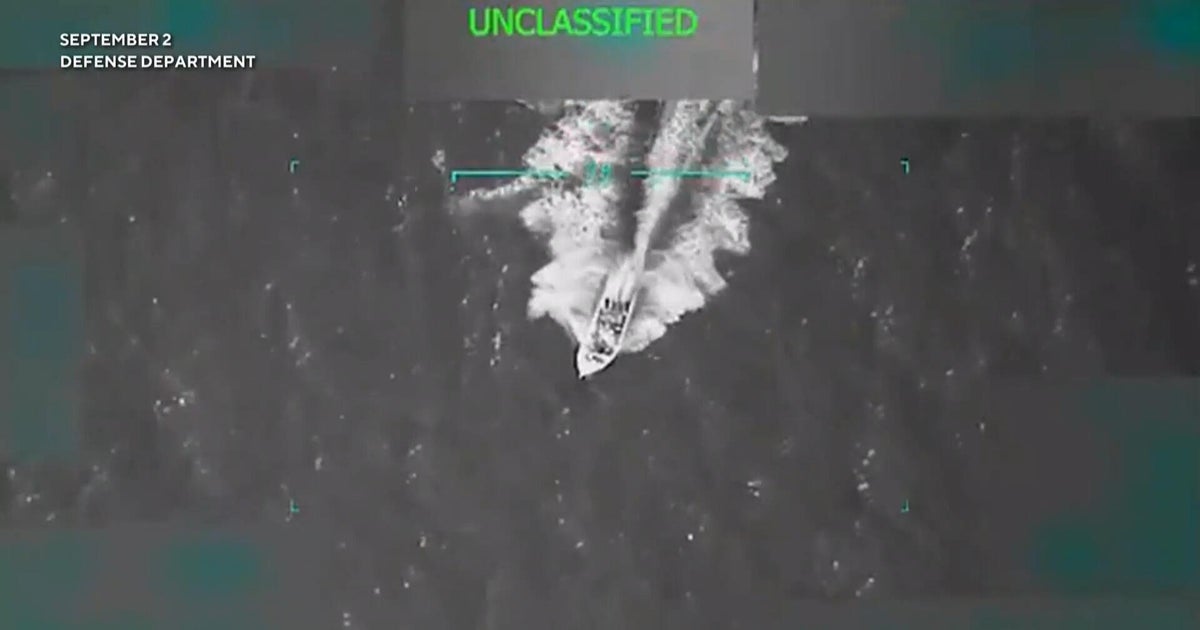

The attack of the US military in early September on the alleged Venezuelan drug boat — first salvo in a months-long series of attacks — has drawn new attention in recent days, as the White House confirmed that the vessel was struck twice.
Confirmation followed a The Washington Post report that the first boat was hit a second time, killing a couple of survivors – prompting calls for an investigation and concerns in Congress that the subsequent strike may have constituted a war crime. A Pentagon manual on the law of war says that combatants who are “wounded, sick or shipwrecked” no longer pose a threat and should not be attacked.
The Trump administration has defended the series of boat raids, citing them as a necessary tactic to stem the flow of narcotics from South America. But US officials have not provided concrete evidence that the ships were smuggling drugs or that they posed a threat to the US. Some MPs of both parties questioned the legality of the strikes.
Here’s what we know about the September 2nd strike and what the administration said:
September 2: Trump says military ‘shot at boat’
President Trump told reporters during a Event from September 2nd that the U.S. “literally shot a boat” from Venezuela that he claimed was carrying drugs earlier that day.
In social media posts later that day, Mr. Trump and Secretary of State Marco Rubio detailed the attack and referred to it like one blow.
The president said further Truth Social that the strike killed 11 alleged members of the Tren de Aragua, a Venezuelan gang that his administration indicated as a terrorist group earlier this year. Mr Trump posted a 29-second video showing one strike on the boat.
Mr. Trump said the ship was headed for the U.S., but Rubio he said later in the day that the drugs were “probably destined for Trinidad or another country in the Caribbean.”
The next day, Rubio he stated that she “ended up heading for the United States.”
September 3: Hegsett says he “watched live”
Defense Secretary Pete Hegseth dismissed a Venezuelan official’s claim that the Sept. 2 strike footage may have been faked, telling “Fox & Friends” the next morning: “I was watching live. We knew exactly who was in that boat. We knew exactly what they were doing.”
September 4: US had ‘absolute and complete authority’ to strike ship, Hegsett says
Asked by CBS News what legal authority the Pentagon cited to strike the boat, Hegseth says, “We have absolute and complete authority to do it. He called the importation of drugs into the US an ‘attack on the American people.’
In addition, the White House told Congress on Sept. 4 that it believed the strike was “consistent with (the president’s) responsibility to protect the interests of Americans and the United States abroad and to advance the national security and foreign policy interests of the United States,” the statement said. later obtained would CBS News.
September 11: The boat was reportedly spinning
The New York Times and CBS News report the boat appeared to be spinning when hit. A source familiar with the matter told CBS News that those on board saw a military aircraft overhead and tried to turn back before the U.S. struck the boat.
White House spokeswoman Anna Kelly said in a statement: “The president acted in accordance with the laws of armed conflict to protect our country from those who try to bring poison to our shores.”
September 15: Another boat was hit
Mr. Trump announces a new strike against an alleged drug-carrying ship in the Caribbean, killing three “male terrorists”.
The administration later said the US was in a “non-international armed conflict” with drug cartels in a message to Congress justifying the September 15 strike that reviewed by CBS News. They called the three people killed in the second attack “illegal fighters”.
In total, the US struck more than 20 boats between early September and mid-November, killing more than 80 people.
October 16: Key admiral announces retirement
Hegset announces that Adm. Alvin Holsey will retire as commander of the US Southern Command at the end of the year. For a year in his tenure, Holsey oversaw the region where the boat strikes took place. Typically, combatant commanders serve an average of three years.
Separately, CBS News reported that two people survived an attack on a boat in the Caribbean on October 16. Trump later said yes the survivors would be sent back to their countries of origin. The two, from Ecuador and Colombia, were returned to their homeland within a few days of the strike.
November 28: Report says the first attack left survivors who were then killed in the second attack
The The Washington Post reports that there were two survivors of the September 2nd strike, who clung to the wreckage of the boat before dying in the ensuing attack. The Post reported that the second attack was carried out because Hegsett ordered everyone killed.
Hegset it’s called reporting “fictitious, inflammatory and derogatory”.
“The declared intent is to stop the deadly drugs, destroy the drug boats and kill the narco-terrorists who are poisoning the American people,” Hegseth wrote on X. “Every human trafficker we kill is connected to a specific terrorist organization.”
He also once again defended the legality of the strikes.
In response, the top Republican and Democrat on the Senate Armed Services Committee said in a joint statement on Nov. 28 that they would conduct “vigorous oversight to determine the facts surrounding these circumstances.” Similarly, the leaders of the House Armed Services Committee issued a statement promising to collect a full accounting of the operation.
November 30: Senator says it could rise ‘to the level of a war crime’
Democratic Senator Tim Kaine of Virginia he says on “Face the Nation with Margaret Brennan” that the report of the subsequent strike “rises to the level of a war crime if true,” pointing to international and domestic laws on attacks on wounded combatants.
Rep. Mike Turner, an Ohio Republican who serves on the House Armed Services Committee, expresses similar concerns, speaking“Obviously, if that were to happen, it would be very serious, and I agree that … it would be an illegal act.”
November 30: Trump responds
On Air Force One, the president tells reporters he “wouldn’t want” another attack on the ship.
He added that Hegsett said he did not order the next strike and that “I trust him 100 percent.”
December 1: Leavitt confirms second strike
White House Press Secretary Caroline Leavitt confirms that there was a subsequent strike, but denied that it was done at Hegseth’s behest. She says that Adm. Mitch Bradley, who led the Joint Special Operations Command at the time of the operation, authorized Hegseth to carry out the strikes.
The reporter asked Leavitt, “Is the administration denying that the second strike happened, or is it happening and the administration is denying that Secretary Hegsett gave the order?”
She replied, “The latter is correct.”
Leavitt then read a prepared statement: “President Trump and Secretary Hegsett have made it clear that narco-terrorist groups designated by the President are subject to lethal targeting in accordance with the laws of war. Regarding the September 2nd strikes in question, Secretary Hegsett authorized Admiral Bradley to conduct these kinetic strikes, and the Admiral guided the law well in accordance with the law. to ensure that the ship is destroyed and the threat to the United States of America is eliminated.”
Leavitt later told CBS News senior White House correspondent Weijia Jiang that she “rejected” that Hegsett ever said that everyone on the boat on Sept. 2 should be killed.
December 1: Senate Armed Services Chairman says he expects to receive all audio and video from strikes
GOP Sen. Roger Wicker of Mississippi, chairman of the Senate Armed Services Committee, tells reporters he has spoken with Hegseth and Gen. Dan Cain, chairman of the Joint Chiefs of Staff, and plans to speak with the admiral who led the operation. He said Hegsett “indicated” that “there was a second attack”.
But Wicker told reporters he had no information on survivors who may have been killed. He said he expects to get that information because “we will have all the audio and video.”
December 2: Hegseth says he did not watch the second impact and did not see any survivors
During a cabinet meeting, Hegsett told reporters he had watched the first boat attack on September 2 live, but had “moved on to my next meeting” before the boat was hit a second time.
“I watched that first strike live,” Hegseth said. “As you can imagine, we have a lot of things to do at the War Department. So I didn’t stick around for an hour, two hours, whatever, where all the sensitive exploitation of sites digitally happens.”
He said he later learned Bradley chose to “sink the boat and eliminate the threat,” which Hegsett said was the right decision.
Hegseth also said he did not “personally see any survivors” after the first strike “because the thing was on fire”, calling the situation a “fog of war”.
Meanwhile, Mr Trump said he was “not aware of a second strike” when asked about his comment over the weekend that he would not want a strike to follow.
“For me, it was an attack. It was not one blow, two, three blows,” said the president.
Earlier in the meeting, Hegsett defended the administration’s strategy for attacking vessels, saying, “We’ve only just started hitting drug boats and putting narco-terrorists on the bottom of the ocean.